

Hebrew grammar exercises built on real verbs
Hebrew grammar lives in the verbs: one root, seven binyanim and dozens of forms. Dvash shows every verb you meet with its full conjugation table, and turns those tables into quick exercises.


Two tools for Hebrew verbs
Look a verb up while you read, then practise it in two minutes.
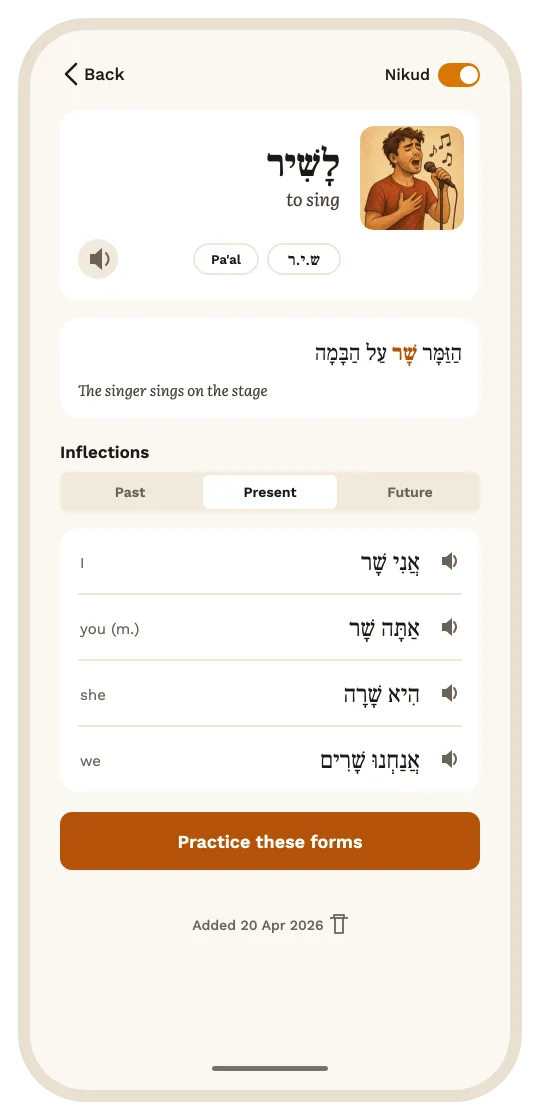
Verb tables
Tap any verb in a story or song and see its full conjugation table: root, binyan, every person and every tense, with audio for each form.
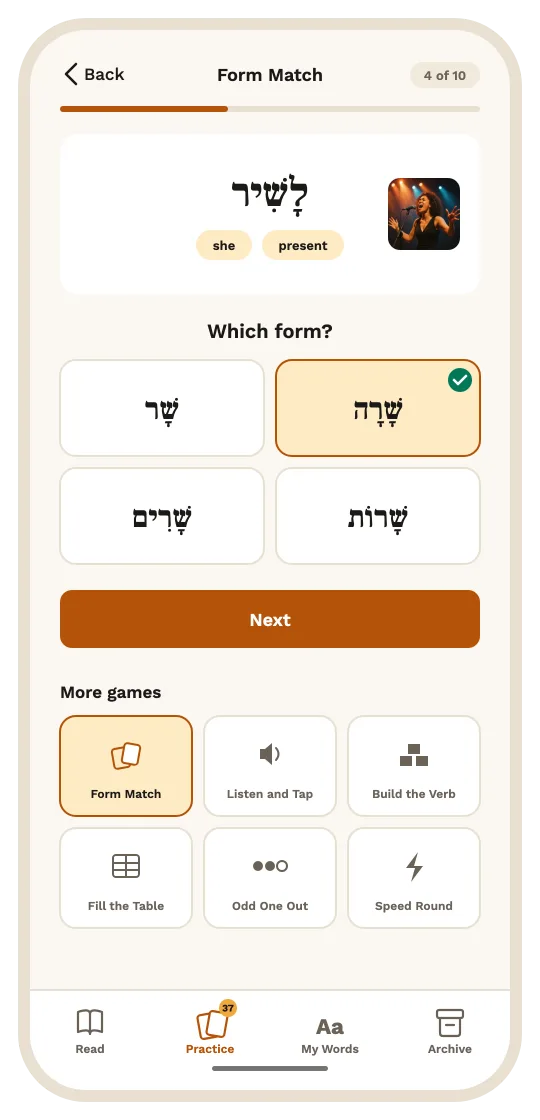
Hebrew grammar exercises as games
Six short Hebrew grammar exercises built on the verb tables, from matching forms to building a verb from its root. Two minutes a day keeps the forms alive.
The seven binyanim in plain words
A binyan is a verb pattern. The same three-letter root takes on related meanings in different binyanim, so learning the patterns multiplies every root you know.
| Binyan | Example | Meaning | Typical use |
|---|---|---|---|
| Pa'al פָּעַל | כָּתַב | he wrote (katav) | The basic, simple action. The most common binyan. |
| Nif'al נִפְעַל | נִכְתַּב | it was written (nikhtav) | Often the passive of pa'al, sometimes reflexive. |
| Pi'el פִּעֵל | דִּבֵּר | he spoke (diber) | Active verbs, many of them newer words. |
| Pu'al פֻּעַל | סֻדַּר | it was arranged (sudar) | The passive of pi'el. |
| Hif'il הִפְעִיל | הִזְמִין | he invited (hizmin) | Often causing something to happen. |
| Huf'al הֻפְעַל | הֻזְמַן | he was invited (huzman) | The passive of hif'il. |
| Hitpa'el הִתְפַּעֵל | הִתְלַבֵּשׁ | he got dressed (hitlabesh) | Reflexive or mutual: doing something to yourself or each other. |
Six grammar games
Each game will use the verb tables of words you have met in your reading, so the practice stays connected to real Hebrew.
Form Match
See a verb form, pick the matching person and tense. Fast recognition of who is doing what, and when.
Listen and Tap
Hear a form read aloud and tap the one you heard. Trains your ear for the endings that fly past in conversation.
Build the Verb
Assemble the form from its pieces: root, prefix, ending. The way the language is actually built.
Fill the Table
An inflection table with gaps. Fill them in and watch the whole pattern take shape.
Odd One Out
Four forms, one does not belong. Spot the wrong tense, person or binyan.
Speed Round
As many forms as you can before the clock runs out. For the days when the other games feel easy.
Grammar sticks when it comes from reading
A conjugation table is easier to remember once you have seen its verbs in a story you understood. Dvash gives you both: today's news and songs in easy Hebrew, and a table for every verb in them. Read a story and tap a verb. From the next app update, you can then play a short game with the forms you just met.
Questions about Hebrew grammar
What is the hardest part of Hebrew grammar?
For most learners it is the verbs: each one belongs to a binyan and changes for person, gender, number and tense. The good news is that the patterns are regular, so every verb you learn makes the next one easier.
How many binyanim does Hebrew have?
Seven: pa'al, nif'al, pi'el, pu'al, hif'il, huf'al and hitpa'el. Pa'al, pi'el and hif'il are the most common, and they are the best place to start.
How do I practise Hebrew verb conjugation?
Little and often. Look up the verbs you meet in real texts, read their tables aloud, and test yourself on a few forms a day. In Dvash every verb has a table with audio, and the grammar games turn those tables into two-minute exercises.
Are the grammar games available now?
The verb tables are in the app today. The six grammar games arrive in the next app update.
Practise Hebrew verbs from what you read
Get the app, read today's story and tap a verb to see its table. Free to start.