Biblical vs Modern Hebrew: Which Should You Learn?
If you want to read the Hebrew Bible in the original, learn biblical Hebrew. If you want to talk with Israelis, read Israeli news or live in Israel, learn modern Hebrew, and know that a good share of what you learn will carry over if you later turn to the other.
Biblical vs modern Hebrew is one of the first questions many learners ask, and the answer depends on what you want to do with the language. Both use the same alphabet and the same system of roots. They differ in vocabulary, in how verbs show time, in word order and in pronunciation. Here is what that means in practice.
Same language, different eras
Biblical Hebrew is the language of the Hebrew Bible, written down over many centuries. Modern Hebrew grew out of it, along with later layers such as the Hebrew of the Mishnah and medieval writing, and was revived as an everyday spoken language from the late nineteenth century. Today it is the main language of Israel, used at home, at work, in schools and in the media.
An Israeli child can read many verses of Genesis and understand them, in the same way an English speaker can follow much of Shakespeare. The reverse is harder: someone trained only in biblical Hebrew will find an Israeli newspaper or a conversation in a café very difficult at first.
The main differences
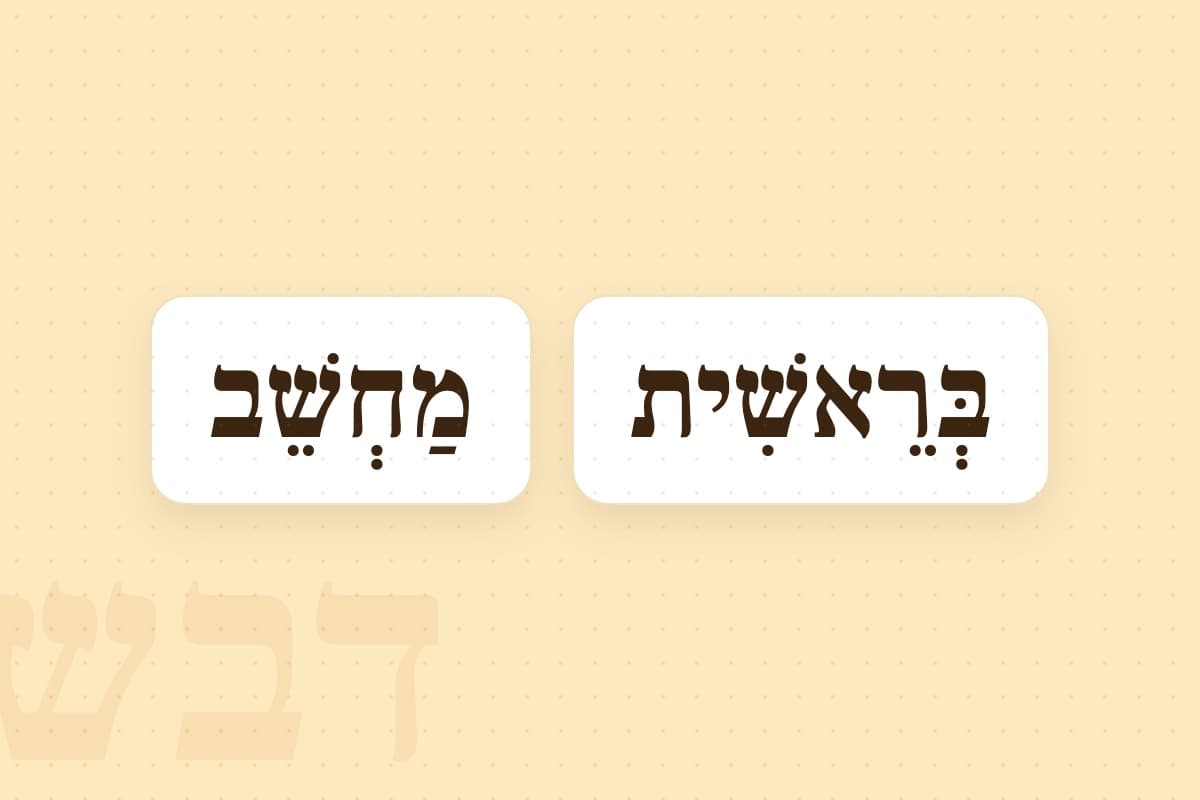
Vocabulary. Modern Hebrew needed words for things that did not exist in ancient times. Many were built from old roots. The word מחשב (machshev, computer) comes from the root ח-ש-ב (ch-sh-v), "to think". עיתון (iton, newspaper) comes from עת (et, time). Some biblical words were given new jobs: חשמל (chashmal) appears in the book of Ezekiel for a shining substance, and today it means electricity. Modern Hebrew also borrowed words from European languages and Arabic, so a modern speaker uses many words a biblical reader has never seen.
The verb system. This is the biggest change.
- Biblical Hebrew has two main verb forms that mostly describe whether an action is complete or ongoing. Stories often use a special form with the prefix va-: וַיֹּאמֶר (vayomer, "and he said"). It looks like a future form, yet it tells a past event.
- Modern Hebrew has three clear tenses: past, present and future. Katav (כתב) is "he wrote", kotev (כותב) is "he writes" and yikhtov (יכתוב) is "he will write". The va- form for telling stories has dropped out of everyday use.
Word order. Biblical narrative often puts the verb first: וַיֹּאמֶר אֱלֹהִים (vayomer Elohim, "And God said"). Modern Hebrew usually puts the subject first, as English does: דני אכל תפוח (Dani akhal tapuach, "Dani ate an apple").
Possession. Biblical Hebrew often attaches endings to nouns: סוּסוֹ (suso, his horse). Modern Hebrew can do the same in formal writing, but in speech people usually say הסוס שלו (ha-sus shelo, the horse of his).
Pronunciation. Modern Israeli Hebrew has simplified some sounds. Most Israelis pronounce ט and ת the same way, ק and כ the same way, and א and ע the same way. Biblical Hebrew courses use different systems. Some teach the modern Israeli pronunciation, some use an academic reconstruction, and many religious communities keep their own reading traditions, such as Ashkenazi, Sephardi or Yemenite. Each serves its own purpose well.
What carries over
The good news is that the foundations are shared.
- The alphabet. The same 22 letters, including the five final forms.
- Nikud. Printed Bibles are fully vocalised with the dots and dashes that mark vowels, and learners of modern Hebrew also start with nikud.
- Roots and patterns. Most words in both forms of the language are built from three-letter roots. The verb patterns, called binyanim, are largely the same.
- Core vocabulary. Many everyday words have not changed: בית (bayit, house), מים (mayim, water), לחם (lechem, bread), יום (yom, day), ארץ (eretz, land), שלום (shalom, peace, hello).
- Pronouns and basic grammar. אני (ani, I), הוא (hu, he), the article ה (ha-, the) and many prepositions work the same way.
A learner who has studied one form of Hebrew for a year usually finds the other much easier to pick up than a complete beginner would.
Who should learn which
Learn biblical Hebrew if your main goal is to read sacred texts closely. That includes Jewish learners preparing to read from the Torah, studying commentaries or praying with more understanding, Christian students of the Old Testament in seminaries and churches, and anyone of any faith, or none, who wants to read these texts in their original language. A biblical Hebrew course will spend its time on the forms and vocabulary you will meet in those texts.
Learn modern Hebrew if you want to speak with people. That includes olim and anyone planning to move to Israel, people with Israeli family or friends, travellers, students heading to an Israeli university, and anyone who wants to follow Israeli news, music, films and television.
Consider both if you want to read the Bible and also visit or live in Israel. Many people start with modern Hebrew because speaking and listening every day builds vocabulary fast, then add a biblical course and find the grammar easier to follow. Others come from biblical study and add modern Hebrew to hear the language spoken and to practise it in conversation. Both routes work.
A short word on religious learners
Hebrew is precious to many communities, and people come to it with very different hopes. Some want to pray in the words of their tradition. Some want to read prophets and psalms the way they were first written. Some want to understand the songs their grandparents sang. Each of these goals is a good reason to learn, and each can start with the same alphabet.
Where Dvash fits
Dvash teaches modern Hebrew. Every day it publishes Israeli news stories and Israeli songs in easy Hebrew, at four levels, with tap-to-translate on every word, nikud you can switch on or off, audio, My Words flashcards with spaced repetition, and verb tables for each verb. If you studied biblical Hebrew and want to see how the language is used today, it is a gentle way in. If you learn from outside Israel, see how Dvash works for learners abroad.
Quick answers
Can an Israeli read the Bible? Most Israelis can understand much of the Hebrew Bible, especially the stories, and study it at school. Poetic books and rare words are harder.
Is biblical Hebrew harder than modern Hebrew? Biblical Hebrew has a smaller vocabulary but a less familiar verb system and no spoken practice. Modern Hebrew has a larger vocabulary but you can hear and use it every day. They are hard in different ways.
Does modern Hebrew use the same letters as the Bible? Yes. Both use the same square Hebrew script.