
Hebrew Nikud: When to Drop the Vowel Marks
Hebrew nikud is the set of small dots and dashes that show vowels, and most learners can start reading without it once they know a few hundred common words and the basic verb patterns. Children's books, poetry and prayer books use nikud, while adult texts in Israel, from newspapers to street signs, are almost always written in Hebrew without vowels.
This post explains what nikud is, where you will still see it, why adults manage without it, and a practical path for moving from one to the other.
What is nikud?
The Hebrew alphabet has 22 letters, and they are all consonants. Some of them can also stand for vowels, which we will come back to. To show every vowel precisely, scholars in the early Middle Ages, known as the Masoretes, developed a system of marks written under, above and inside the letters. That system is called nikud (ניקוד), from a root meaning "dot".
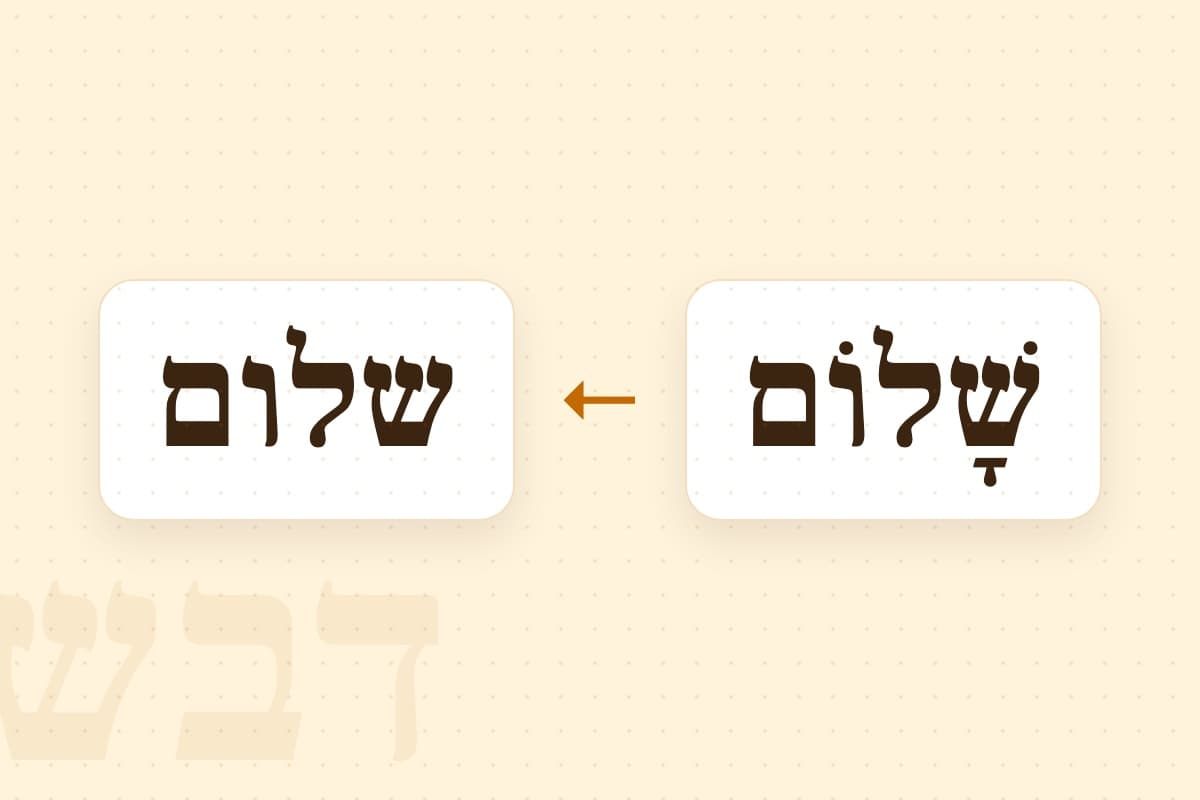
Here is the word for peace, shalom, with and without nikud:
- With nikud: שָׁלוֹם
- Without nikud: שלום
The dot above the first letter tells you to read it as sh. The small T-shape under it is the vowel a. The dot above the ו (vav) tells you to read it as o. Without the marks, the reader already knows the word, so the letters are enough.
Where Israelis see nikud
Israelis still meet nikud in a few specific places:
- Children's books and school readers. Young children learn to read with full nikud, and it stays in their books for the first years of school.
- Poetry and song lyrics in print. Poets often add nikud where a word could be read two ways, or where the rhythm depends on the exact vowels.
- Prayer books and the Bible. Siddurim and printed Bibles are fully vocalised.
- Materials for learners. Ulpan textbooks and easy-Hebrew readers for new immigrants usually include nikud.
- Single tricky words. An adult text sometimes adds one vowel mark to a word that could be misread, or to a foreign name.
Everything else, from newspapers and websites to text messages, menus and road signs, is written without nikud.
Why adult texts drop it
Fluent readers fill in the vowels from context. When you read I bought fresh ___ at the shop, you guess the missing word from the context before you even look at it. Hebrew readers do this all the time with vowels.
Take ספר. Without nikud it could be:
- sefer: book
- sapar: barber
- sfar: border area, outlying region
In a sentence, there is almost never any doubt. "I read a ספר" is a book. "I had my hair cut at the ספר" is a barber. Nikud also takes skill to write correctly, and Hebrew keyboards and phones make it slow to type, so adults simply leave it out.
Ktiv male: the letters that help you
When nikud is dropped, Hebrew spelling adds extra letters to help. This is called ktiv male (כתיב מלא), "full spelling". Linguists call these helper letters matres lectionis, Latin for "mothers of reading".
The two most important helpers are:
- ו (vav) for the vowels o and u. In שלום the vav gives you the o in shalom. In שולחן (shulchan, table) it gives you the u.
- י (yod) for the vowel i, and sometimes e. The verb siper (he told) is spelled סיפר without nikud. The yod tells you there is an i after the first letter, which separates it from ספר (sefer, book).
So the same root can look a little different in a children's book and in a newspaper. A child reads סִפֵּר with nikud. An adult reads סיפר with an extra yod. Once you know this, many "strange" spellings in news articles make sense.
The vowel a usually gets no helper letter, so you will still need context for many words. That is where vocabulary and patterns come in.
A practical path to reading without vowels
You can make the move gradually. Here is a path that works for most learners.
1. Learn to read with full nikud. In your first weeks, read everything with vowel marks. Your goal is to connect letters with sounds and read short words aloud correctly.
2. Learn the helper letters. Notice how ו and י behave in words you already know. Compare the same word with and without nikud.
3. Reread known texts without nikud. Take a short text you have already read with vowels and read it again without them. Because you know the words, your brain fills in the gaps. This builds the skill gently.
4. Read first, check second. With new texts, try reading without nikud, then switch it on to check yourself. You will see your guesses get better week by week.
5. Learn the verb patterns. Hebrew verbs follow patterns called binyanim. Once you know that words like מדבר (medaber, speaks) and מספר (mesaper, tells) share a pattern, you can read many new verbs without help.
6. Read a lot. The more words you know, the less you need the vowels. Short daily reading of news or song lyrics will do more than occasional long sessions.
Most learners find they read comfortably without nikud on topics they know well first, such as daily life or the weather, and keep nikud for new topics for a while longer.
Common worries
Will I get the pronunciation wrong? At first, sometimes. Listening to the text read aloud while you follow along fixes most mistakes quickly.
Should I learn to write with nikud? For most adult learners, no. Israelis rarely write with nikud themselves. Reading it is useful. Writing it is a specialist skill.
Is Hebrew without vowels harder for learners than for Israelis? Yes, because Israelis already know the words. The gap closes as your vocabulary grows.
How Dvash helps
Dvash publishes today's Israeli news and Israeli songs in easy Hebrew at four levels, and every story has a nikud switch. Read with vowels when a story is new, then turn them off and try again. Tap any word to see its translation, listen to the audio to check your reading, and save new words to My Words for spaced-repetition review. You can see all of this on our features page.